On July 15, 2026, the Israeli government approved a NIS 497 million reduction to GR-550. NIS 345 million will be allocated to the Israel Security Agency (Shabak) and NIS 132.4 million to the Israel Police to combat organized crime in Arab communities.
The approved reduction is smaller than the NIS 568 million cut initially proposed. Nevertheless, it represents one of the largest cuts to the five-year plan since its adoption. The decision is part of an ongoing effort by Social Equality Minister, May Golan, and Minister of Internal Security, Itamar Ben Gvir, to shift funding away from five-year socio-economic development plans for Arab society and to increase the role of the Shabak in crime prevention in Arab society.
The move has been controversial—firstly, it suggests that socio-economic development for Arab society is competing, rather than complementary to crime prevention. Secondly, by increasing the use of counterterrorism agencies, the type of law enforcement needed to address the crime crisis in Arab communities is reframed. The desperation for action on crime is so great in Arab society that increased enforcement is widely welcomed, but whether this should be done by police or counterintelligence agencies raises major policy concerns.
The Israel Democracy Institute and the Institute for National Security Studies are two examples of policy institutions arguing that this kind of diversion undermines the strategic logic on which Government Resolution 550 rests. In 2025, IDI researchers wrote that while “reducing disparities in education, employment, planning, public services, and community resilience is, first and foremost, a matter of democratic values and equal opportunity, consistent investment in all these areas also get to the core causes of crime and violence.” The INSS paper also argues that reducing violence requires both targeted action against criminal organizations and broader efforts to strengthen social, economic, and institutional resilience in Arab society.
According to a letter (e-mail) circulated by the Cabinet Secretary the cuts would affect programs across multiple sectors, including employment, local authorities, industrial zones, culture and sports, and water infrastructure. In comments submitted during the interministerial review process, several ministries cautioned that the reductions could delay implementation of existing programs, reduce services, and affect ongoing efforts to narrow socioeconomic disparities between Arab and Jewish citizens.
Many civil societyand political leaders in Arab society oppose expanding the Shabak’s role The Association for Civil Rights in Israel (ACRI), together with the National Committee of Heads of Arab Local Authorities in Israel, Itach Ma’aki – Women Lawyers for Social Justice, and the Mossawa Center, filed a petition with the Supreme Court. The petition challenged the government’s decision. The organizations are asking the Court to cancel the decision and rule that the Shabak lacks the authority to address civilian crime, and to issue an interim injunction preventing both the budget cuts and the Shabak’s involvement in combating crime until the petition is decided.
Some Arab public officials have argued that the brutality of the crisis validates the use of all legal tools available to the state. Several Arab local authority heads, including Firas Badhi, Mayor of Kafr Qara, and Jamil Bassoul, Head of the Reina Local Council, called to advance the legal measures necessary to enable the Shabak participation in the fight against organized crime. Badhi and Bsoul in statements to Kul-Alarab, “reaffirmed their support for involving the Shabak in efforts to curb violence and crime” and added that “there is not a single mayor who sleeps peacefully at night because of the violence and crime.”
Currently, the remaining funds yet to be allocated in GR-550 are NIS 839 million. However, actual budget reductions to Arab society stand to be much larger. GR-550 budgets are conditioned on matching funds from the relevant implementing government ministry. When the core budgets are cut, the individual ministries also do not allocate their own funds towards GR-550.
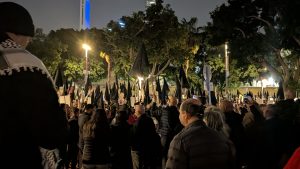
Jewish-Arab Demonstration against crime in Arab society, January 31, 2026, Tel Aviv
Proposal to Divert GR-550 Funds to Ministry of National Security
Nothing matches your search
Sorry, we couldn't find anything matching your search. Please try again.
How Can We Help?
Do you need support integrating these resources and issues into your philanthropic, communal, or Israel education work? Reach out for consultations, connections to experts, program support, training, or to plan your next event or mission. If you’ve used our resources, tell us about your experience!
How Can We Help?
Do you need support integrating these resources and issues into your philanthropic, communal, or Israel education work? Reach out for consultations, connections to experts, program support, training, or to plan your next event or mission. If you’ve used our resources, tell us about your experience!