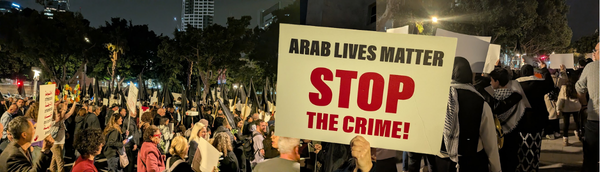
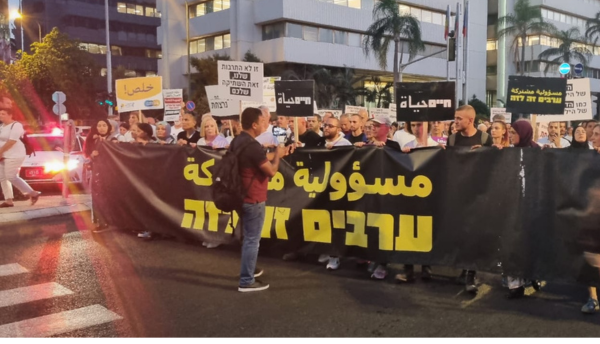
In January 2026, major demonstrations were held in Sakhnin and Tel Aviv against the unabetted rise of violent crime in Arab communities and the state’s inadequate protection. These protests marked a turning point in mobilization, drawing tens of thousands of Arab citizens to Sakhnin, and tens of thousands of Arab and Jewish citizens together to Tel Aviv one week later, underscoring that personal security is shared civic concern. Rasool Saada, Kulan CEO one of the demonstrations’ organizers: “The past few months have been frightening and paralyzing, marked by near-total lawlessness and a complete collapse of restraint. In January alone, 28 people were murdered.”
Strike and Protest in Sakhnin
Sakhnin, an Arab town in northern Israel with a long history of civic activism, became the focal point of a large-scale strike and rally, as residents faced a surge in extortion and threats across Arab towns. The strike began when a local business owner, Ali Zbidate refused to pay protection money, inspiring others to close their workplaces in solidarity. The High Follow-Up Committee for Arab Citizens of Israel declared a general strike including businesses, schools, and public services in Arab localities, in solidarity with Sakhnin. Within days, the strike spread to over thirty Arab localities, drawing widespread participation across many sectors of the community: doctors, lawyers, teachers, parents’ committees, and other professionals, demanding urgent action to address escalating crime and protect residents.
On January 22, the town hosted a massive march, drawing around 50,000. Protesters called for action rather than silence, urged Arab political leaders to unite and represent Arab society’s needs more effectively, appealed to Jewish society to acknowledge the shared stakes in public safety, and challenged the current government for cutting budgets and neglecting their communities.
Speaking at the rally, Sakhnin Mayor Mazen Ghanayem captured the sense of abandonment: “In a proper democratic country, can it be that citizens are killed morning, noon and night and no one cares? <..> What are we asking for? Personal security and peace of mind. These are not impossible demands. I write letters everywhere, and in the end the violence and protection rackets only grow, as if we are not citizens of the state.”
Jewish participation at the Sakhnin demonstration was limited, yet expressions of solidarity followed. Several Jewish organizations conducted solidarity visits to the protest tent in the days after the rally. Jonathan Hefetz, Seeds of Peace, shares: “These are our partners, our graduates and our community members, people whose lives, safety, and dignity should matter not only to us, but also to the authorities. Their lives are not disposable. Their security is not negotiable, and their blood is not forfeit.”
On the same day as the march, leaders of the four Arab political parties convened in Sakhnin and signed a pledge to run together as a Joint List in the upcoming elections. “The scale of mobilization made it impossible for Arab political parties to remain fragmented or passive without appearing disconnected from their own constituencies. <…> The public pressure was enormous and impossible to refuse,” Ta’al Chairman Ahmad Tibi.
Tel Aviv Demonstration: “We are with you – you are not alone”
The momentum from Sakhnin carried into Tel Aviv on January 31 with a major demonstration organized by the High Follow-Up Committee for Arab Citizens of Israel and the National Council of the Arab Mayors, together with civil society organizations. The protest drew about 50-60,000 participants, roughly 40% Arab and 60% Jewish, the largest Jewish turnout ever for a demonstration organized by the High Follow-Up Committee, creating an unprecedented moment of Jewish-Arab civic mobilization.
At Habima Square, speakers from across Israeli society, including bereaved families, and civic leaders from the North and South, Muslim, Druze, and Jewish, addressed the crowd and emphasized that the right to live safely is fundamental for all residents of Israel. The High Follow-Up Committee chairman Jamal Zahalka framed the protest as a direct challenge to systemic inaction: it was a “cry against crime and against the government feeding it” and a call to “cancel the silent agreement between the police and criminal organizations.” He rejected claims that crime is an Arab cultural problem and blamed law enforcement for practicing a “policy of deadly restraint” and denounced National Security Minister Itamar Ben Gvir as the “minister of crime.”
During the rally, families of victims shared their grief, while Arab and Jewish participants stood together under the slogans “We want to live” and “Arab lives matter. Stop the violence.” Protesters described the solidarity that was felt on the ground “We are with you; you are not alone.” Batya Kalus, SVF, emphasized how this call, which for two years of the war symbolized the struggle to bring the hostages, was now marking “a defining moment in Arab–Jewish relations… the implicit message in this cry is that Arab citizens are not alone in this struggle. Even more fundamentally, what connects us is this compassion for one another.” Another Jewish participant shared: “It really felt like the part of Israeli society that wants true justice and equality for all was finally uniting against this government and voting and praying with our feet for these cherished values – actually fighting for our future and even our lives.”
Haneen Majdla observed that for Arab citizens this was not just a protest against organized crime, but “rather the breaking up of two years of silencing, living under suspicion, and fear <…> the sudden release of pressure that had been suppressed for a long time when they took to the streets—even if the main reason for this was crime.”
According to organizer Rasool Saada, it was important for Arab citizens to have Israeli society recognize their right to live safely and see them as full citizens exercising their rights. The demonstration created a rare moment of social solidarity between Jews and Arabs and positioned personal security as a shared civic cause and right.
Ayman Odeh, Hadash Chairman, framed the demonstration as “a turning point, another important building block for the common struggles of Jewish and Arab society… It is also an opportunity to call on Arab citizens to partake in protests against the [judicial] coup. This is a common struggle for all of us.”
Next Steps
“These protests are not one-off events; they mark the beginning of a broader social justice movement rooted in Arab citizens’ demands for safety, dignity, and meaningful political participation,” shares Rasool Saada.
Aida Touma-Suleiman, a Hadash lawmaker, highlighted the political importance of the movement ahead of the upcoming elections: “We understand that protests by themselves cannot reduce the murders and that this struggle won’t end in a day. We need a political struggle that will end up with large voter turnout.”
Plans to continue public activism include escalation of protests and strikes, while demonstrations in Arab localities continue. In Mazra’a village, a recent protest marked a year since the murder of pediatrician Abdallah Awad, with the crowd chanting the names of other victims and the village council pledging to “keep our voices raised high” until children can grow up safely.
Organizers now work on sustaining the momentum while producing “quick wins” that residents can feel in their daily lives. Efforts include continued civic protests, targeted strikes, and escalation of public activism in Arab towns.
An operations room was opened after the rally in Sakhnin coordinating logistics, police liaison, and volunteer mobilization. Women and grassroots committees are leading initiatives, particularly in local towns, and municipalities are establishing coordinated local security measures.
Following the January demonstrations, on February 5th, the High Follow-Up Committee for Arab Citizens of Israel announced preparations for a three-day general strike. During the strike days, dates yet to be announced, workplaces, municipalities, businesses, services, and public institutions in Arab localities are expected to stay closed. The Committee began coordination with trade unions, workers’ committees, local authorities, and civil society organizations to protect participants’ labor rights, prevent punitive measures by employers, and broaden participation in the protest. As part of the planned strike, the Committee called for participation in a national “March of Disruption,” set to depart from the Galilee, gather participants along major highways, and conclude in Jerusalem.
The movement emphasizes the need for continued Jewish-Arab civic partnership, keeping personal security as a shared demand and fostering collaboration with Jewish volunteers and organizations. Beyond immediate activism, there is a clear aim to link civic engagement to political influence, including mobilizing Arab citizens for upcoming elections, forcing internal political unity, and shaping government priorities in response to community needs.